No. 03 strategy
Getting Better at Anagrams
Anagrams gives you eight letters and five minutes. Here's what I've learned from playing my own game.
It assumes you know the rules. If you don't, the how-to has them, with an example animation. There's no hint button and no penalty for a wrong guess, so what you control is how you spend the clock and the order you search in. Most of what follows is about the search.
What the score rewards
Every day is built from one eight-letter word, and its letters arrive in The eight letters of the day. You tap them to build a word, and Shuffle reorders them. scrambled. Points climb steeply with length.
Three four-letter words are worth less than one six. The full-rack word on its own beats eleven fours.
Because your scoring tier comes from your share of what the day was worth, a sparse day and a crowded day are judged on their own terms. While you play, the bar under the clock names your scoring tier, the next one, and the score it starts at.
The start card tells you how many words the day holds, and that should change how you play. On a crowded day the quick sweep pays. On a sparse one, the long words are most of your score.
Hunt families, not words
The usual advice for word games is to know more words. It's true and it's useless, because you can't act on it in the next five minutes. Hunt The word left when you take an ending off a longer one: PLAY inside PLAYER. It's also the piece a front like RE attaches to. instead.
English builds families from a small stock of endings. A verb takes S, ED, ING, and ER. A noun takes S and often Y or ISH. RE, UN, DIS, and MIS work at the front. So a rack that gives you one member of a family usually holds three or four, and the letters you needed for the first are most of what you need for the rest.


All five come out of one rack: P, L, A, Y, E, R, and S, plus any eighth letter. Finding PLAY is worth 10 points. Finding it and then spending fifteen seconds on its relatives is worth 180. You didn't need a single new word for that, only to stay on one after it was accepted.
Type the plural, then the ING, then the ER and the ERS. A rejected guess costs you nothing but the second it took to type. It works backwards too: when a long word lands, take its ending off, because the stem is usually a word and often takes an ending you haven't tried.
Shuffle breaks the picture
The shuffle button re-rolls the order of the rack whenever you ask, and that's all it does: the words and your score stay exactly as they were. It's there because eyes get stuck.
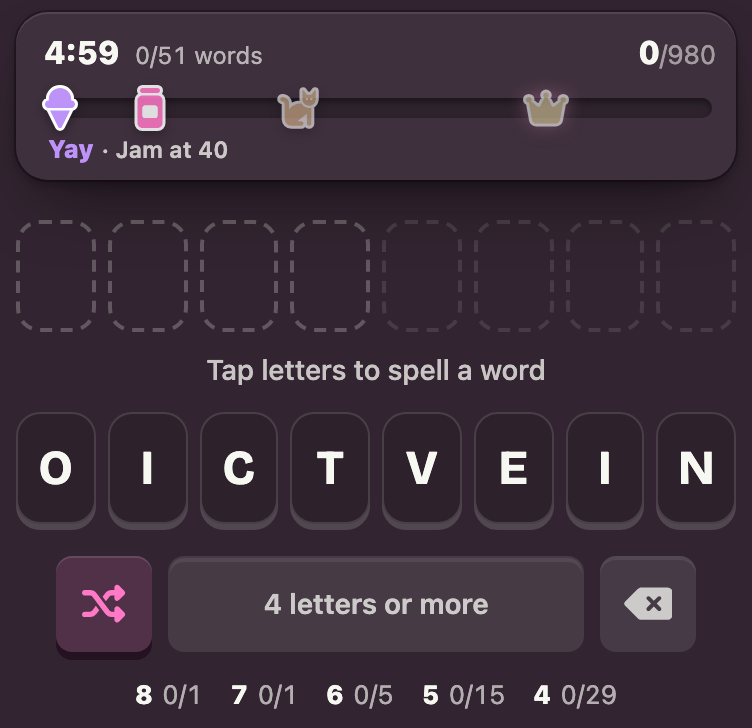
- The clock, then the words and the points you have, each against the day's total.
- The bar. Under it, your scoring tier and the score the next one starts at.
- The rack, below. Every word comes out of these eight letters, and the dashed row fills as you type.
- Shuffle, beside the enter key and delete. Until a word is long enough, the enter key says what it's waiting for.
- Found against total at each length, longest first. The 8 is the full-rack word.
Stare at one order long enough and you stop seeing eight letters and see one picture, and it's already given you all it will. Shuffling breaks it. The obvious time is when you run dry, but it does more right after a long find, when you're most locked into the order that produced it.
Spending the five minutes
A round has a shape: an opening sweep where words arrive for free, a middle where you work stems, and a scramble at the end.
- Open with what you can already see. Bank the first words without auditing them. Ten points is ten points, and typing the short ones warms up the letters.
- Work each stem as it lands. That's the family drill, and if I could keep one habit on this list, it would be this one.
- Never stall on a suspicion. If you're sure a long word is in there and can't see it, leave it and keep typing short ones. The long word tends to turn up while you're busy, and the short ones score in the meantime.
- Read the counters. Under the buttons, each word length has a tally of found against total. It tells you what's left, and what doesn't exist: with no counter for seven letters, there's no seven-letter word today.
- Spend the last thirty seconds cheaply. The clock turns amber under thirty seconds and red under ten. Type every half-plausible word you've been sitting on.
The clock only runs while the game is in front of you. Switch tabs or answer the door and it waits. It used to run on wall-clock time, and I changed it after enough real days with real interruptions in them.
Going after the long one
Every day's letters come from one real word, so 120 points for the full rack are on the table every time. You find it by guessing its shape and testing the guess against the rack.
Shapes to try on the rack
ING · ERS · IER · IEST
TION · MENT · ABLE · NESS
Endings, tried at the back of the rack.
RE · UN · IN · DIS · OVER · MISFronts, tried at the other end.
Take the endings first. Hold one at the end of the rack and look at the four or five letters left, because a five-letter stem is something you can judge and eight loose letters is not. If the leftovers don't look like a word, the ending is wrong. Put it back and try the next, fast.
Then try the fronts, RE or UN held at the start. Let spare vowels steer the endings: a rack with an I and an O to spare is worth trying for TION or SION. That still leaves the finding to you, out of a handful of shapes instead of every order of eight letters.
Most of the words that beat me are ordinary words in a shape I didn't think to try. That's why the dimmed list at the end of a round is the best practice the game hands you, and a missed day in the archive gives you another list to read.
One note about the scoring tiers. The cuts for Jam, Cat, and Wow were set by hand, before there was real play to tune them against. If one feels wrong, that's my number and not your play.